Oxytocin Acetate: Practical Guide for Bench Researchers
On a humid morning in a behavioral neuroscience lab, a postdoc thaws a set of oxytocin acetate aliquots, checks the lot-specific certificate of analysis, and prepares microinfusions for a social-recognition experiment. The protocol has been used before, but small differences in reconstitution, storage, and assay method will change the signal. Those small differences are where experiments live or die.
Chemistry and molecular properties Oxytocin is a nonapeptide (nine amino acids) with the sequence Cys–Tyr–Ile–Gln–Asn–Cys–Pro–Leu–Gly. A disulfide bridge links the two cysteines, forming a six-membered ring plus a three-residue tail. That ring is essential for receptor recognition. The nominal molecular weight of oxytocin is approximately 1007 Da; the acetate salt form used in many research preparations adds an acetate counter-ion without altering the peptide sequence or primary pharmacology.
As a small peptide, oxytocin is water-soluble but sensitive to acidic and basic hydrolysis, proteolysis, and prolonged exposure to ambient temperatures. It carries no prosthetic groups; its biological activity derives from the intact peptide conformation and the ring formed by the disulfide bond. Minor chemical modifications (deamidation, oxidation of sulfur atoms, peptide bond cleavage) reduce receptor potency and can complicate interpretation if not monitored.
Receptor pharmacology and signaling Oxytocin acts primarily at the oxytocin receptor (OXTR), a class A G protein–coupled receptor expressed in brain and peripheral tissues. Canonically, OXTR couples to Gq/11 proteins, activating phospholipase C, increasing IP3 and diacylglycerol, and mobilizing intracellular calcium. In some cell types and assay conditions, alternative coupling and β-arrestin recruitment have been reported; downstream signaling can therefore vary with receptor density, cell type, and ligand concentration.
Potency is typically in the low nanomolar range. Reported EC50 values depend on the assay: some cell-based IP3 or calcium assays report half-maximal activity near 0.1–10 nM, while whole-tissue bioassays or behavioral endpoints require higher local concentrations due to diffusion and metabolism. Cross-reactivity with vasopressin receptors (V1a, V1b, V2) becomes an experimental concern at higher ligand concentrations, since vasopressin family receptors share structural similarity and overlapping peptide recognition motifs.
Forms, formulation, and typical experimental concentrations Research oxytocin is commonly supplied as an acetate salt in lyophilized vials. Lyophilized peptide is preferred for stability and transport. Before use, researchers reconstitute the lyophile in sterile water, saline, or buffer depending on the planned assay. The acetate counter-ion does not change the peptide backbone; it mainly affects solubility and pH.
What counts as a "typical" concentration depends on context. Key ranges reported in the literature include:
In vitro cell-based assays: 0.1–100 nM, depending on endpoint sensitivity and receptor expression. Brain slice electrophysiology: bath concentrations often between 10 nM and 1 μM to overcome tissue diffusion barriers. Microinfusion into defined brain regions: literature reports a wide span—confirm site volume and infusion rate used in the relevant model before selecting an amount.
Those numbers are descriptive of published work; pick concentrations with an eye toward receptor selectivity and off-target activation of vasopressin receptors. When possible, include pharmacological antagonists or genetic controls to confirm OXTR-specific effects.
Handling, storage, and reconstitution Peptides are temperature-sensitive. Store lyophilized oxytocin at ≤ -20°C, ideally in a sealed container with desiccant and minimal freeze–thaw cycles. Many labs aliquot lyophilized peptide into single-use vials when possible to avoid repeated access to the same vial.
Reconstitute with sterile, nuclease-free water or buffered saline. Use aseptic technique. Prepare small-volume working stocks and freeze aliquots at -20°C or -80°C for long-term storage. Avoid more than two to three freeze–thaw cycles per aliquot; repeated cycles accelerate degradation. Short-term (days) storage of reconstituted peptide at 4°C is common; for longer storage, keep aliquots frozen.
Monitor pH: extreme acid or base will hydrolyze peptide bonds. If the downstream assay is pH-sensitive, choose a buffer that maintains physiological pH while remaining compatible with the receptor pharmacology and the biological preparation.
Assays and quantification: pitfalls and best practices Measuring oxytocin in biological matrices is notoriously tricky. Plasma and cerebrospinal fluid concentrations are low—often in the picogram-per-milliliter range—so analytical methods need sensitivity and specificity. Two broad approaches are common: immunoassays (ELISA/RIA) and mass-spectrometry (LC–MS/MS).
Immunoassays are widely used but vulnerable to cross-reactivity and matrix effects. Many commercial ELISA kits report decent sensitivity, but raw plasma often contains binding proteins and proteases that interfere. Solid-phase extraction (SPE) before assay improves specificity and removes matrix constituents that produce false positives. If an ELISA is used, validate it in-house against an orthogonal method when possible—mass spectrometry is the standard comparator.
LC–MS/MS offers sequence-specific detection and can distinguish oxytocin from modified or degraded fragments. However, LC–MS methods require robust sample cleanup, stable-isotope-labeled internal standards, and instrumentation capable of low-picogram detection limits. Even with mass spec, proteolytic degradation during sample handling is a major source of error.
Avoiding antibody cross-reactivity and sample degradation Two practical steps reduce false signal:
Add protease inhibitors (for example, aprotinin) and EDTA at sample collection when compatible with downstream assays. Immediate cooling and rapid freezing limit ex vivo degradation. Acidify samples (commonly to pH ~3) prior to SPE to improve peptide recovery and reduce protease activity; then neutralize for the assay if required. Document any chemical treatment—acidification can affect assay response differently across platforms.
Finally, use spike-and-recovery and dilution-linearity experiments to validate any assay in your specific matrix. Those controls reveal extraction efficiency, matrix suppression, and nonlinearity before experimental samples are run.
Common experimental applications and model-specific notes Oxytocin features in a wide array of preclinical studies. Common application areas include social and maternal behavior, synaptic physiology, circuit-level modulation, and ex vivo smooth muscle contractility assays. Each application imposes different demands on dosing precision, timing, and measurement.
Behavioral neuroscience often uses acute central infusions or genetic manipulations to study OXTR function in social interaction paradigms. Electrophysiologists use bath application or local puffing in slices to probe synaptic modulation; oxytocin can change excitability, synaptic strength, or plasticity depending on cell type and receptor localization. Peripheral physiology studies—such as uterus or mammary gland contractility in isolated tissue baths—use oxytocin as a bioactive control to characterize receptor responsiveness.
Keep these model-specific points in mind:
Species and strain differences matter. OXTR distribution and vasopressin receptor profiles vary between mice, rats, and other species. Results in one strain may not generalize to another. Receptor desensitization and internalization occur with sustained exposure. Short exposures or intermittent dosing reduce tachyphylaxis in many preparations. Local metabolism in tissue can limit effective exposure; concentrations that produce clear effects in cell lines may need to be higher in tissue slices or in vivo.
Controls, off-targets, and experimental design pitfalls Good controls separate true receptor-mediated actions from artifacts. Because oxytocin and vasopressin peptides are structurally similar, high concentrations of oxytocin can activate vasopressin receptors and produce confounding effects. Include one or more of the following where relevant:
Selective OXTR antagonists applied in parallel to test for receptor specificity. Vasopressin receptor antagonists to rule out cross-activation. Genetic controls such as OXTR knockout tissue when available.
Other common pitfalls:
Peptide degradation during handling inflates variance and can produce apparent loss-of-function. Use aliquots and protease inhibitors where compatible. Vehicle effects. If reconstituting in a buffered saline with carrier protein or cyclodextrin, run vehicle-only controls. Batch-to-batch variability. Certificates of analysis should list purity (HPLC), identity (mass spec), and water content. Track lot numbers and replicate key experiments across lots if possible.
Sourcing, quality assurance, and safety Research-quality oxytocin acetate is available from peptide suppliers as lyophilized powder with a certificate of analysis (CoA). A typical CoA will report peptide purity by HPLC (commonly ≥95%), identity by electrospray or MALDI mass spectrometry, and elemental analysis or residual solvents when relevant. When you receive a new lot, verify the CoA, then store aliquots as described above.
Institutional compliance is part of good sourcing. Oxytocin is a regulated pharmaceutical in clinical settings; for research use, follow institutional policies for procurement, storage, and waste disposal. For animal work, obtain IACUC approval for protocols involving administration of peptides. For recombinant or bioactive agents, check if your institution requires an institutional biosafety committee (IBC) review.
Workplace safety is straightforward: treat oxytocin as a bioactive peptide. Use gloves, eye protection, and standard laboratory containment for biologicals. Spills of dilute solutions can be cleaned with detergent and water; follow your facility's chemical hygiene plan for concentrated solutions and dispose of waste according to institutional guidelines.
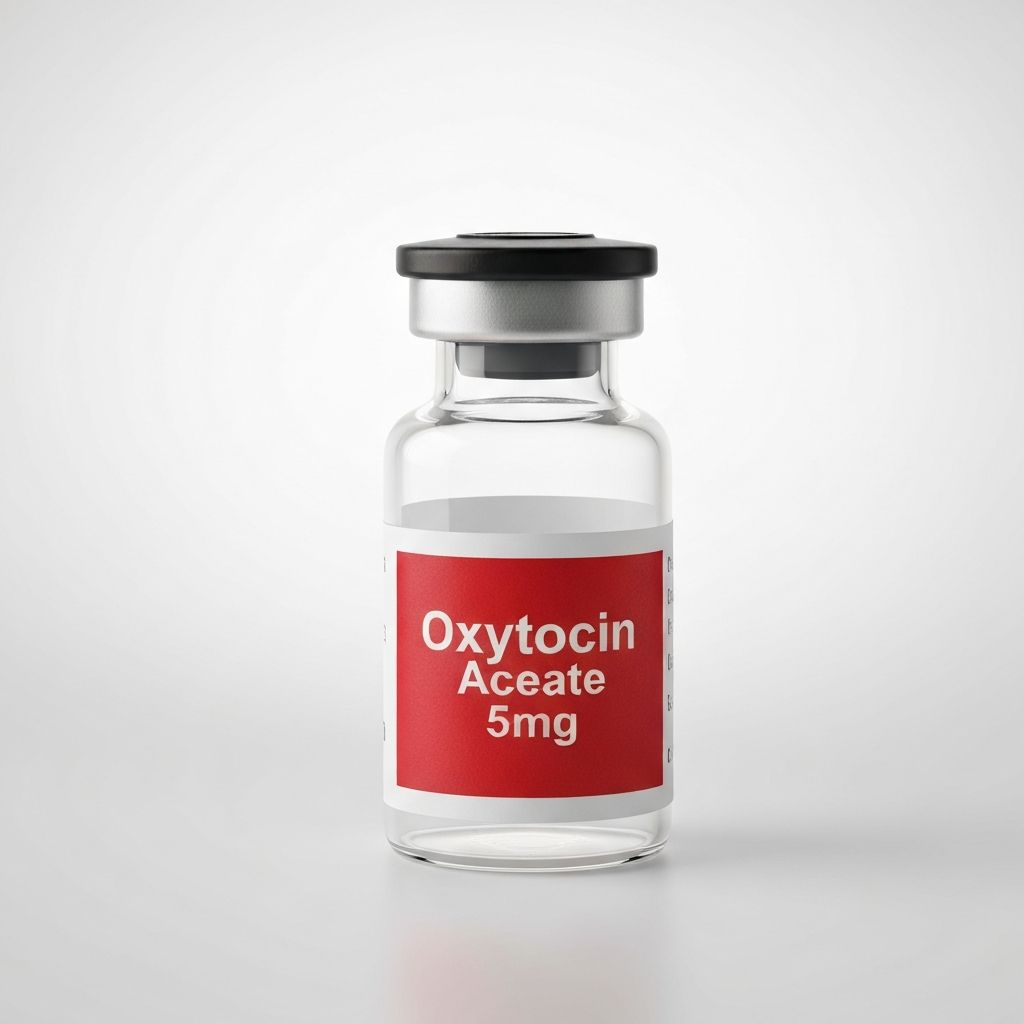
For sourcing convenience, our lab uses verified research peptides with lot documentation and stability data. See product details and CoA with each lot when ordering:
Design checklist before running a study Before you start an experiment, run through these practical checks. They catch the small things that break reproducibility.
Confirm lot purity and identity via the supplier CoA; consider in-house LC–MS spot checks for critical experiments. Decide on solvent and buffer early. Ensure the vehicle is compatible with the biological preparation and that vehicle controls are included. Plan for protease inhibition or rapid freezing for all biofluid samples destined for quantification. Include receptor antagonists or genetic controls to verify on-target effects. Document freeze–thaw history, aliquot sizes, and storage temperatures in the lab notebook and the electronic inventory system.
A quick word on reproducibility: publishing negative data is as valuable as positive findings when methods are transparent. Report exact lot numbers, reconstitution protocols, storage conditions, and assay validation steps. Those details are often the difference between reproducible science and a mysterious nonreplication.
Closing scene The postdoc at the bench labels each thawed aliquot, logs the CoA and storage history, and runs a small QC plate before the behavioral cohort is dosed. The experiment continues only after those small checks pass. That attention to protocol—consistent handling, validated assays, and clean controls—keeps the signal honest. For labs working with oxytocin acetate, those steps are the quiet work that makes the results credible.
All content in this article is intended for laboratory research use only. It does not constitute medical advice, clinical guidance, or dosing recommendations for humans. Follow institutional policies and regulatory requirements when acquiring and using research peptides.